A British home computer from 1982 is playing Go on OGS, and a developer in Taiwan has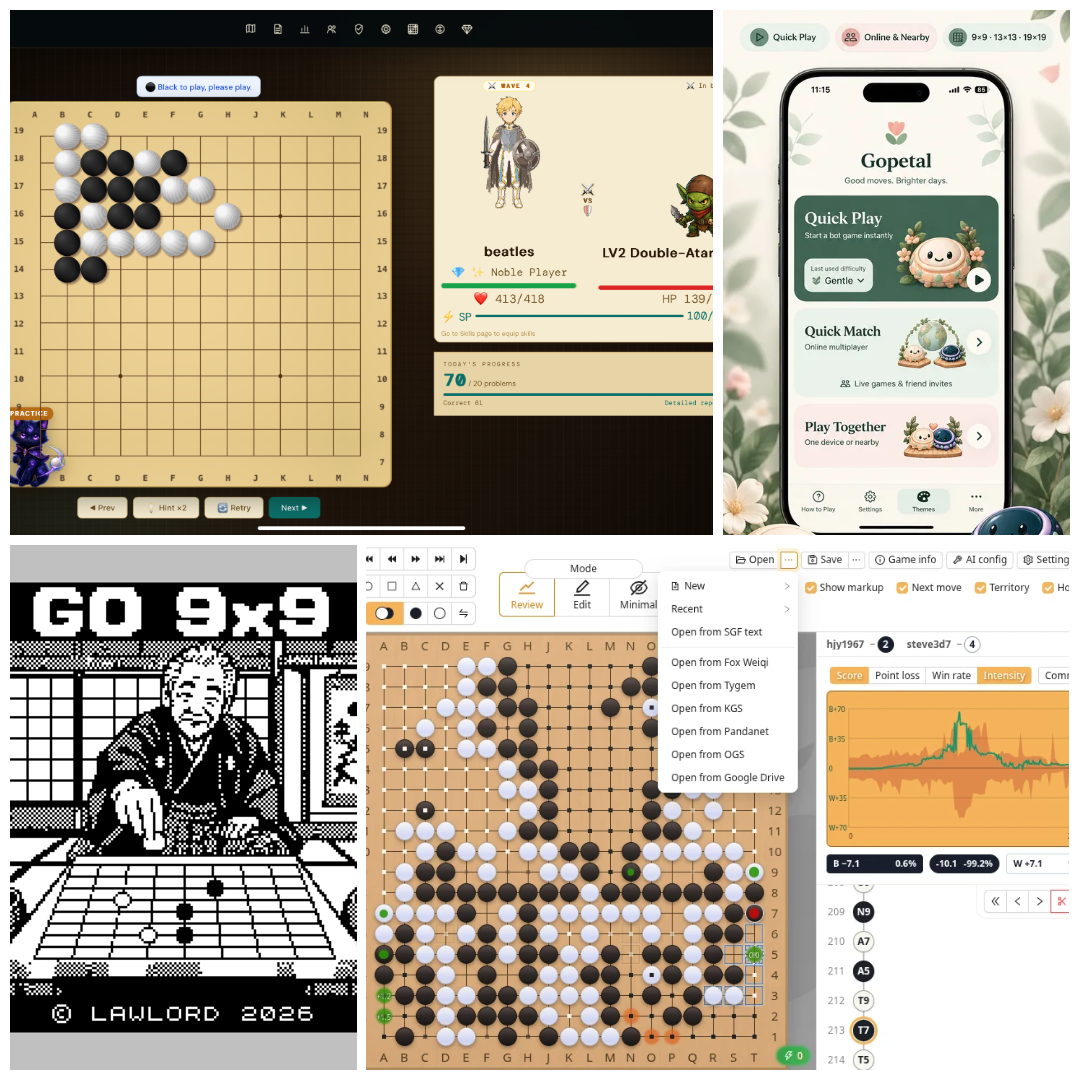 launched a role-playing game built around tsumego practice. This E-Journal roundup also looks at a review tool that turns board photos into editable game records and an app with free lessons and offline puzzles.
The ZX Spectrum learns to play Go
Developer Yuri Emelin (LAWLORD) built a 9×9 Go program for the ZX Spectrum, a machine with a 3.5 MHz processor and 48 KB of memory. As far as Emelin has been able to determine, it’s the first Spectrum Go game with a computer opponent. The program uses Monte Carlo tree search and draws on a modern Go AI for its sense of shape, which Emelin packed into 4.4 KB.
The original and a later 128K version play on the Online Go Server as ZX Spectrum 48K and ZX Spectrum 128K, rated about 11 kyu and 7 kyu, respectively, when Emelin wrote in. He also reports a 6–0 win over Bruce Wilcox’s NEMESIS in a six-game match. Emelin used an AI coding assistant and tested ideas over thousands of games. Read his developer notes and see screenshots.
Go Odyssey turns tsumego into an adventure
Jason, an independent developer and Go player from Taiwan, has launched the English-language version of Go Odyssey, a training platform aimed at kyu players. Players solve tsumego to unlock areas, defeat bosses, and level up. Jason designed the platform to help players track their progress and build a study path around the kinds of problems they struggle with. Try Go Odyssey.
Ulugo takes games from server or board to review
Ulugo is a free, open-source SGF editor with a desktop app that runs KataGo locally. Players can review recommended moves, territory, score estimates, and changes in win rate. Ulugo can open records from Fox Weiqi, Tygem, KGS, Pandanet, and OGS. For games played in person, it can recognize a board position from a photo and turn it into an editable SGF. A browser-based editor is also available. Explore Ulugo.
Gopetal offers free lessons and offline puzzles
Valorem Apps’ Gopetal: Go Board Game offers 48 lessons, daily puzzles that work offline, bot practice on 9×9, 13×13, and 19×19 boards, and tools to study, import, and export SGF files. The developer says lessons, puzzles, and gameplay are free, with optional cosmetic purchases and no subscription. Version 3.2.0 is available for iPhone, iPad, and Mac. View Gopetal in the App Store.
Editor’s note — This roundup is based on information supplied by the developers. The American Go E-Journal has not independently evaluated these projects. If you try any of them, we’d like to hear how it went.